A Calendly alternative for founders who want more meeting context
The Yoya TeamJun 26, 2026Updated Sep 4, 20267 min read

You're a founder, so your calendar is a parade of intro calls. An investor who got a warm intro. A prospect who clicked "book a demo." A potential design partner a friend swears you'll click with. Each one is a small audition, and you keep showing up to them half-blind, because all your booking link gave you was a name, an email, and a 30-minute slot at 2pm.
That's the real problem with the form-and-grid booking link. It's great at finding a time and terrible at telling you who's about to walk through the door. So when founders ask me which Calendly alternative they should switch to, my answer surprises them.
The best Calendly alternative for a founder isn't another time-grid tool — it's a conversational booking link that also briefs you before the call, so every intro starts with a qualified, prepped guest instead of a cold form.
That's Yoya. She's an AI scheduling assistant: your guest opens your link and books by chatting in plain language, and you get the time and the story behind it. Let me make the case fairly, because Calendly genuinely does some things well.
Where Calendly is genuinely good
Let's give credit before we pivot. Calendly solved a real, annoying problem, and it solved it well. Before booking links, scheduling a call meant the dreaded email volley — "does Tuesday work? no? how about Thursday at 3, my time, which is your... wait, what time zone are you in?" Calendly killed that, and that was a gift.
It's genuinely strong at the core mechanic: surfacing your real availability, handling time zones so nobody does mental arithmetic, preventing double-bookings, and pushing a clean calendar invite to both sides. It connects to your Google or Outlook calendar, respects your working hours and buffers, and just works. For a lot of simple scheduling — a recurring 1:1, a quick sync with a teammate — that's all you need, and reaching for anything fancier would be overkill.
So this isn't a takedown. If all you want is a mutually open time, the time-grid is a perfectly good answer. The question is whether "a mutually open time" is actually all you need as a founder taking high-stakes intro calls. For those, the time is the easy part. The hard part is everything the grid throws away: who this person is, why they booked, and what would make the next 30 minutes count. That's the gap, and it's exactly where a conversational booking link pulls ahead.
The case for a conversation instead of a form
The booking experience is an early interaction with a guest. Keep the questions relevant and the next step clear. Some guests prefer a short form; others find it easier to explain their request in a conversation. Yoya gives hosts that conversational option. We have not measured a conversion uplift against Calendly.
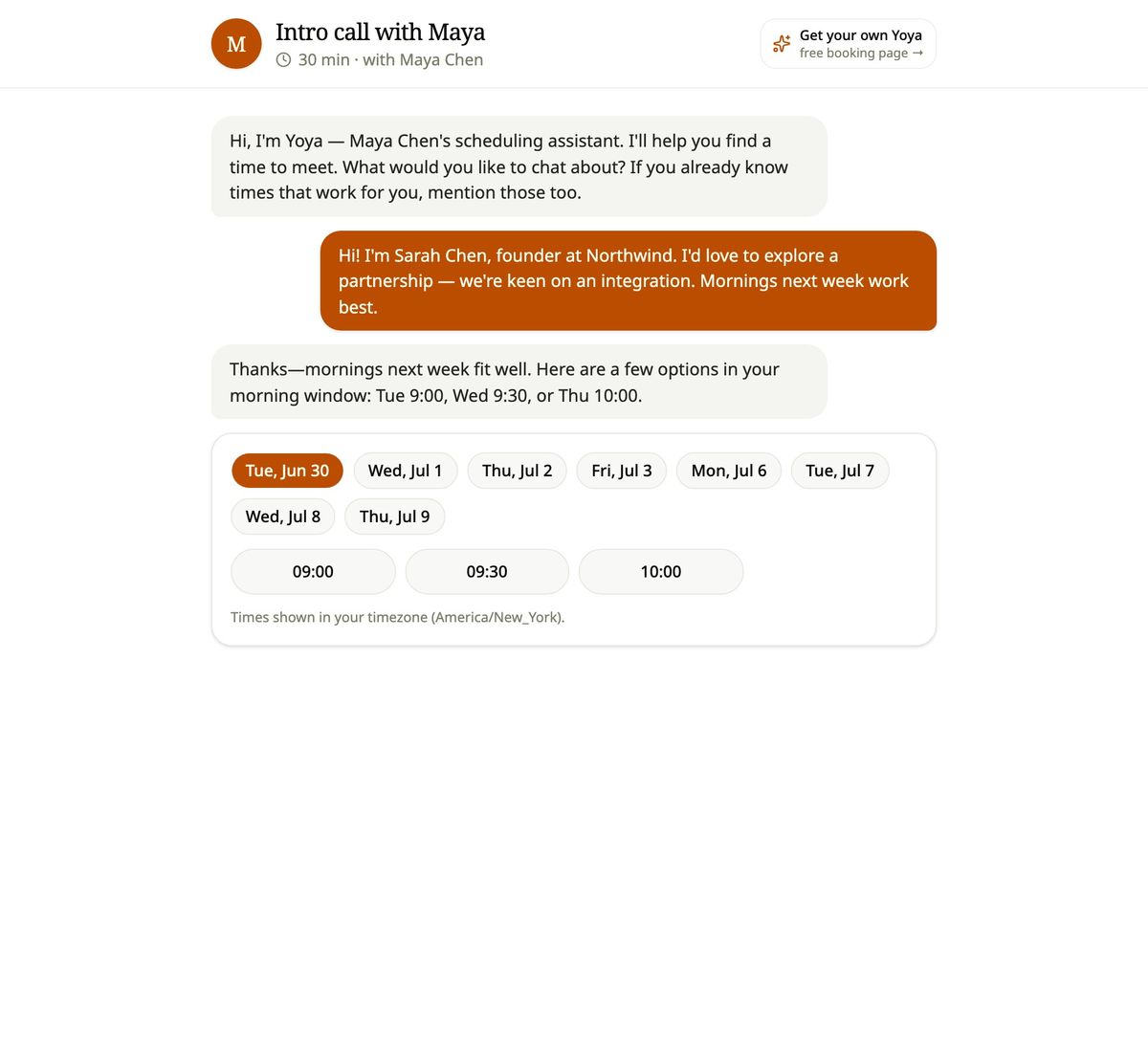
A conversation says something different. When a guest opens your Yoya link, they don't fill out a form — they talk to a named assistant who greets them, offers your real open times, and asks, in a friendly way, what they'd like to discuss. It feels like reaching a thoughtful person who took the request, not a turnstile. For an investor or a potential partner sizing you up, that warmth is not a nice-to-have. It's signal.
And the conversation does double duty. While it feels effortless to the guest, it's quietly capturing a meeting brief — who they are, why they're booking, what outcome they want. The same minute that books the call also qualifies and prepares it. To dig into why this pattern is taking over, see what conversational scheduling actually is. The short version: you stop trading a chat experience for a data-capture experience and get both at once.
Traditional booking link vs conversational booking link
Here's the comparison on the dimensions a founder actually cares about — not feature checkboxes, but what shows up in your day.
| What to compare | Calendly | Yoya |
|---|---|---|
| Choosing a time | Calendar-based booking with availability and time-zone handling | Available times offered within a conversation |
| Guest context | Custom invitee questions; questions can be required | Required page fields and conversational context |
| Before the call | Review invitee answers and enabled meeting tools | Review the brief generated from booking details |
| AI-assisted workflows | Callie and Notetaker are offered with eligible plans; check current availability | Chat booking, paid voice booking, and MCP booking tools |
| Fit | A broad scheduling platform with team and integration options | Conversational guest intake and booking context |
| Information quality | Answers are supplied by the guest | Answers and generated summaries should be checked when important |
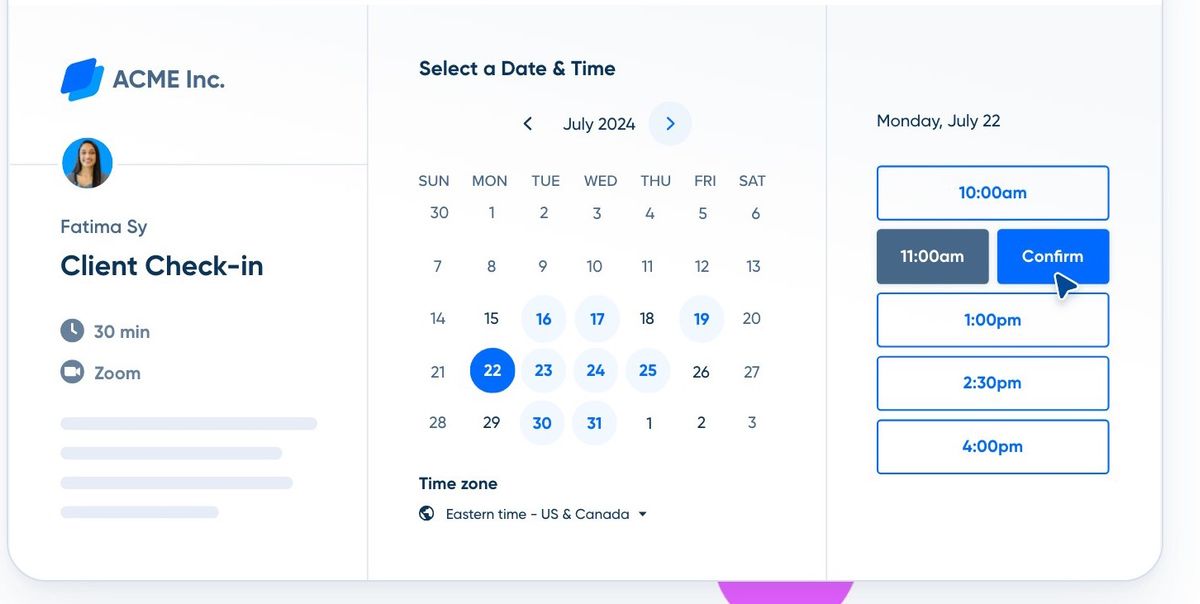
The standard Calendly booking page (source: calendly.com).
The top row is the honest concession: for finding a time, these tools are neck and neck. Every row below it is where the conversation earns its keep — and for a founder, those rows are the whole point.
The brief is the part founders actually want
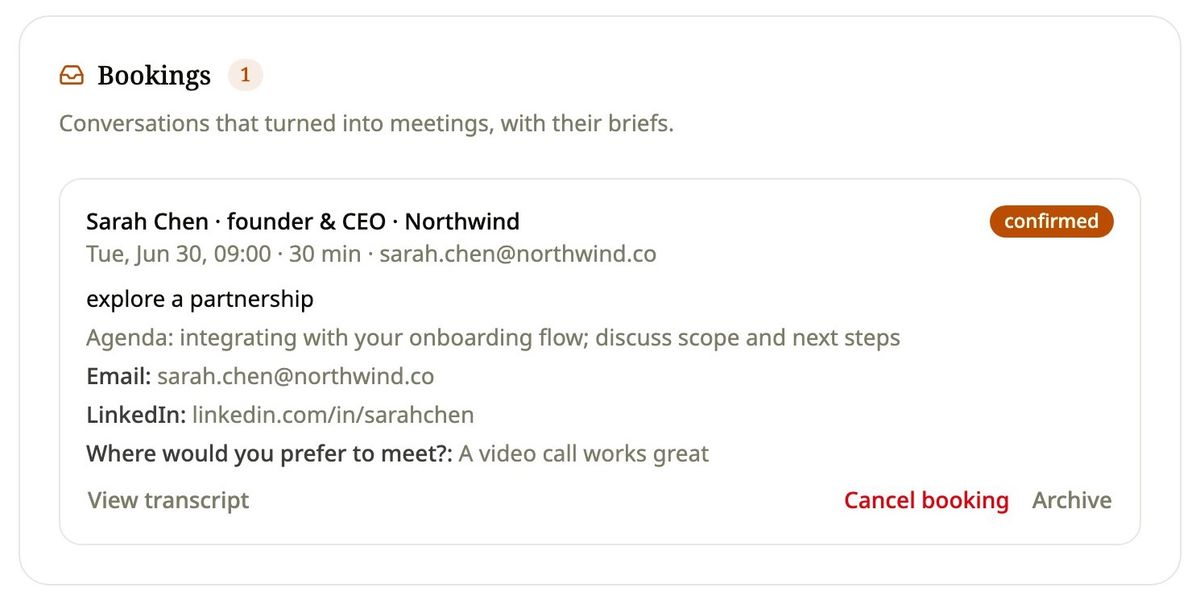
Imagine two versions of tomorrow morning. In the first, you see "Intro call — Jordan Lee, 10:30am" and spend the call's first ten minutes excavating who Jordan is and why you're talking. In the second, you open the invite and there's a short brief: Jordan runs ops at a Series B fintech, found you through a mutual investor, and wants to discuss whether your API can replace a manual workflow before their next board meeting. You walk in already three steps ahead.
That second version is what Yoya hands you before every call. Because the booking happened as a conversation, she's already gathered the context and packaged it into a brief that lands with the calendar invite. You're not preparing — you're already prepared. It's the difference between a guest and a briefed guest, and over a week of intro calls that difference compounds into real momentum.
This is the founder's edge no time-grid can give you. Investors notice when you've clearly read up on them. Prospects feel it when you open with their actual problem instead of a generic discovery script. We wrote a whole piece on this because it matters so much: never walk into a meeting unprepared. For high-stakes intros, showing up cold isn't just awkward — it quietly costs you the deal.
Required fields that actually get filled
Founders love to bolt extra questions onto their booking form. What's your company? LinkedIn? Phone number? Team size? It comes from a good instinct — qualify the call before it happens. But the static form fights you on it. Every required field you add is more friction, more drop-off, and the fields people do fill get a half-hearted "n/a" or a typo'd phone number.
When you configure required fields, Yoya asks for those details during booking. The questions should be useful to the meeting. Requiring a field does not prove an answer is accurate, and a conversation is not identity verification.
The result is qualification without friction. Your guest never feels interrogated, and you never again get a booking with the key field blank. And once the call is confirmed, Yoya closes the loop the way you'd want: a clean calendar invite for both sides, an auto Google Meet link for anything online, and a quick "where should we meet?" for in-person. The logistics are airtight. The difference is you also got the story.
Frequently asked questions
Is Yoya a true Calendly alternative, or just an add-on?
It's a full replacement for the booking link itself. Yoya does everything you rely on a time-grid for — live availability, time zones, no double-booking, calendar invites, auto Google Meet links — and replaces the form-and-grid front end with a conversation that also briefs you. You can retire your old link.
Does the conversation make booking slower for my guest?
No. Most guests find chatting faster and friendlier than scanning a grid and tabbing through form fields. Yoya offers your real open times right in the chat, so picking a slot is quick — and the qualifying questions feel like a normal exchange, not extra work.
What exactly is in the brief I get before a call?
A short summary of who the guest is, why they booked, what they want to discuss, plus any required fields you've set (like LinkedIn or phone). It arrives with the calendar invite, so you can skim it the morning of and walk in genuinely prepared.
Can I require fields like LinkedIn or a phone number?
Yes. Configure the fields your page needs and Yoya collects them during booking. Calendly also supports required invitee questions. Yoya’s distinction is the conversational flow and the brief assembled from the information shared.
Does it handle online and in-person meetings?
Both. For online meetings, Yoya automatically adds a Google Meet link to the invite. For in-person, she asks the guest for a preferred location and includes it. Either way, both sides get a clean invite.
What about time zones and double-booking?
Handled, exactly like you'd expect from a great booking link. Yoya reads your live availability — weekly hours, blocked dates, existing events — and offers times in the guest's own time zone, so there's no math and no double-booking.
So, which one should a founder pick?
If your scheduling needs are simple, a traditional booking link like Calendly is a fine, capable tool — it nails finding a mutual time, and there's no shame in that. But a founder's intro calls aren't simple. They're first impressions with investors, customers, and partners, where showing up prepared is the difference between momentum and a missed shot. For those, a time-grid gives you a slot and leaves you to wing the rest.
A conversational booking link gives you the time and the brief — a warm first impression, qualified guests, and a short summary waiting in every invite. It's like finally hiring the assistant who takes your meeting requests and preps you for each one.
Stop walking into intro calls cold. Meet Yoya, let her handle your next round of bookings, and see what it feels like to know exactly who's walking in before they do.