A 30-Minute Discovery Call Agenda for Consultants
The Yoya TeamSep 13, 20263 min read
Use a 30-minute discovery call to understand the client's situation, decide whether you can help, and agree on a next step. A workable agenda gives the main problem the largest share of the call and reserves a few minutes for the close.
Use the plan below as a starting point and adjust it to what you already know about the client. Yoya's free discovery call agenda generator gives you an editable draft.
The agenda you can use on your next call
| Minutes | Focus | A prompt to start with |
|---|---|---|
| 0–3 | Agree on the purpose | “What would make this conversation useful for you?” |
| 3–9 | Understand the current situation | “Walk me through how this works today.” |
| 9–21 | Explore one important problem | “Can you show me a recent example of where it broke down?” |
| 21–27 | Discuss fit and constraints | “What would need to be true for us to work on this?” |
| 27–30 | Agree on the next step | “Who will do what after this call, and by when?” |
For a 15-minute call, narrow the goal to deciding whether a deeper conversation is worthwhile. Don't try to squeeze a full diagnosis, a presentation, and a proposal into it. If the project needs technical scoping with several people, book a separate working session.
Spend the middle on a real example
Suppose a potential client says their onboarding process is slow. “How slow?” is a reasonable question, but it may get you an estimate nobody has checked. Ask them to describe the last customer they onboarded: where the work started, who handled it, and what held it up.
Then follow the answer. If they mention a handoff between sales and delivery, ask what information was missing at that point. You now have something concrete to investigate instead of a general complaint about efficiency.
Stay with that example long enough to understand the handoff before moving to the next question.
Calendly's discovery-call guidance also recommends open-ended questions, asking one question at a time, and avoiding a premature demo. Use those principles without treating a list of questions as a script you must finish.
Decide what belongs before the call
We recommend asking for a name, an email address, and a small amount of relevant context before someone books. A full questionnaire can wait unless you genuinely need the answers to decide whether the appointment is appropriate.
The client intake questions guide separates short pre-call questions from deeper discussion prompts. If the client already explained why they're reaching out, acknowledge the answer on the call rather than making them repeat it.
Yoya's client intake questions generator produces editable question text. You still choose where to collect the answers. The free generator doesn't host a form or qualify clients automatically.
A template, a question guide, or an agenda generator?
| Starting point | Choose it when… |
|---|---|
| A shared document | You already know the agenda and want the client to comment on it |
| A discovery-question guide, such as Calendly's | You want to improve the questions you ask during sales discovery |
| Yoya's agenda generator | You want a timed outline you can edit for consulting, sales, or a customer interview |
For an ongoing client relationship, a shared document may be all you need. Yoya's generator helps with the first draft; it doesn't research the prospect or take meeting notes.
To try the onboarding example, choose Consulting, set the call to 30 minutes, and enter ‘Improve the client onboarding handoff’ as the topic.
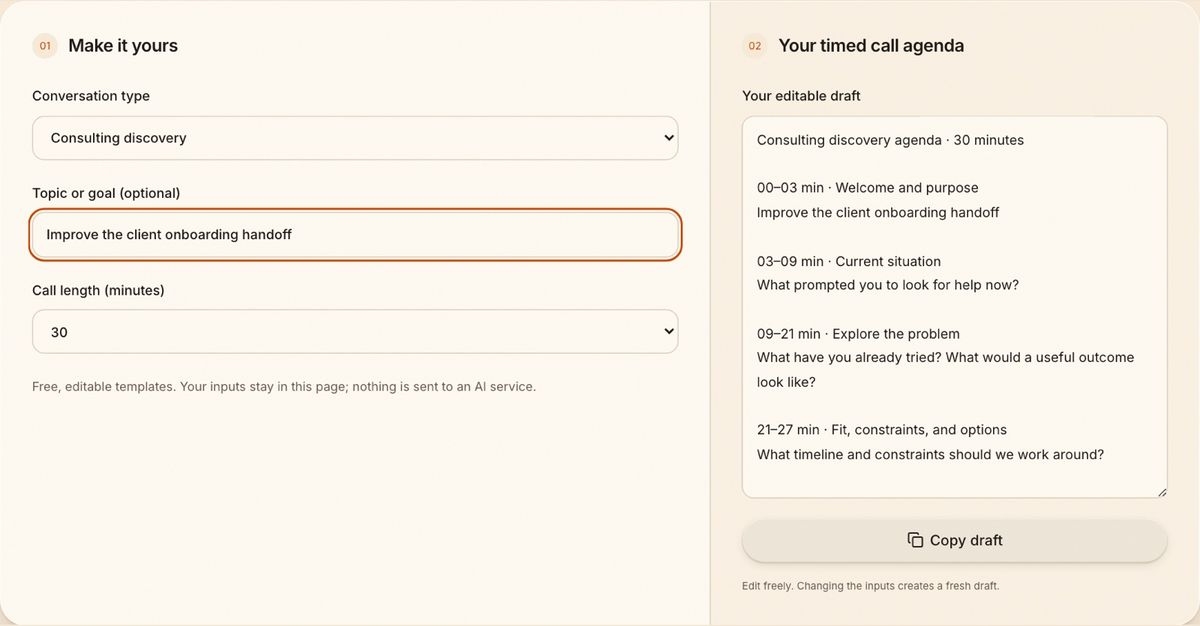
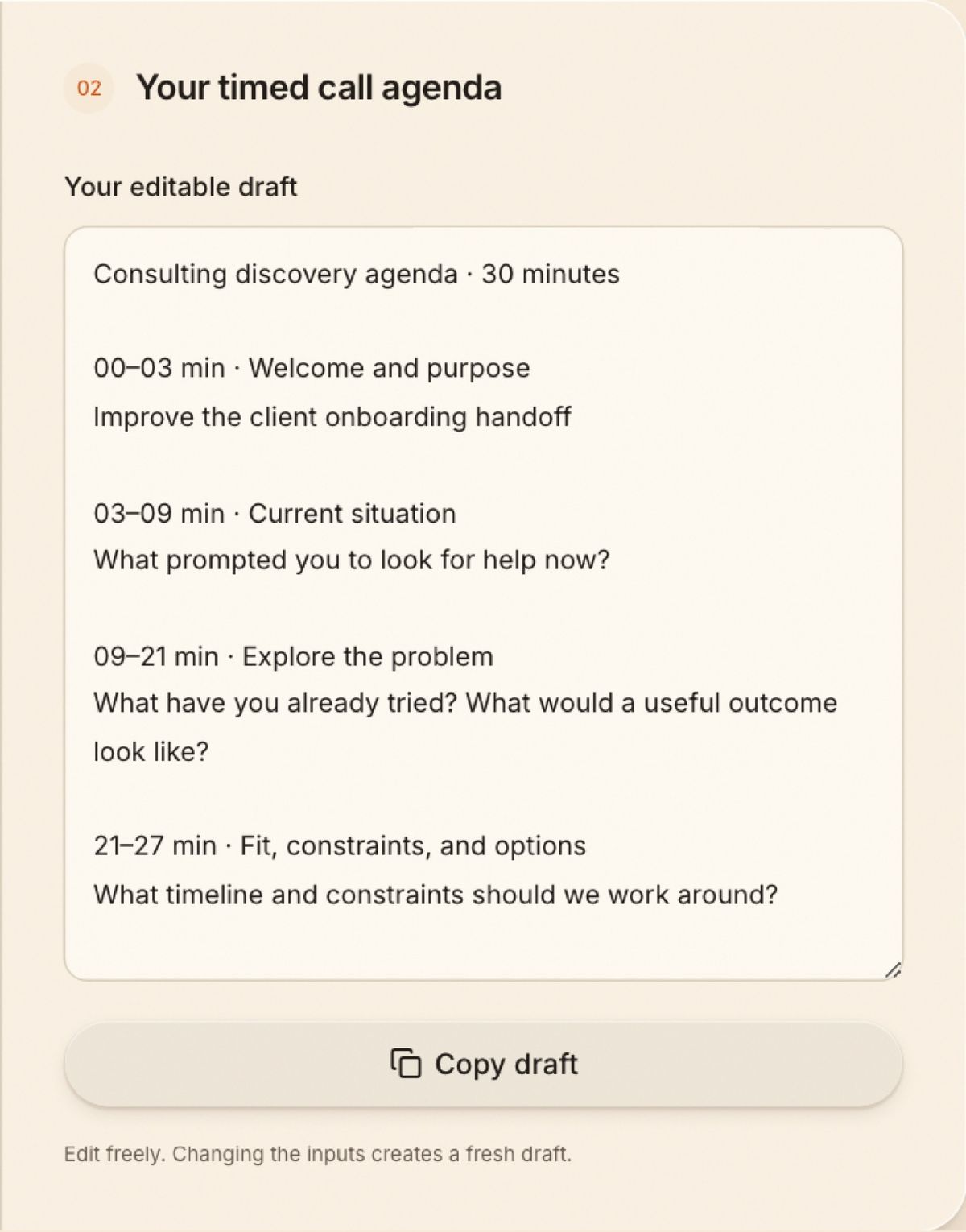
The generated draft follows the same time allocation as the table above. Replace its broad prompts with questions about the client’s actual problem, then copy it into your invitation or shared document.
Close with a decision someone can act on
“I'll send something over” leaves too much unspecified. A more useful close is:
I'll send a one-page scope covering the onboarding handoff by Thursday. You'll check it with your operations lead, and we'll decide whether a scoping session would help.
Sometimes the right close is that you aren't the right person for the job. You can still explain the gap and suggest what kind of expertise the client should look for.
When you send the invitation, include a short version of the agenda. The meeting invitation email templates give you wording for that step. To collect context while a guest chooses a time, see Yoya's consulting booking workflow.
Questions about discovery-call agendas
Should I send the agenda in advance?
Yes, when it helps the guest prepare. Share the purpose, expected length, and a few topics. You don't need to send your entire list of follow-up questions.
Is 30 minutes always enough?
No. It is a useful starting point for an initial conversation. Complex diagnosis, multiple stakeholders, or technical review may need a separate session with a different goal.
Can I use the same agenda for customer interviews?
Change the questions and the close. Ask about the participant's past experience rather than selling a solution. The generator includes a customer-interview option for that reason.