Yoya vs. Chili Piper: which scheduling workflow fits your team?
The Yoya TeamSep 4, 20264 min read

Chili Piper is very good at one specific thing: someone fills in a form on your site, and instead of waiting for a rep to follow up, they're routed to the right person and booked into a meeting on the spot. Speed-to-lead, solved.
The catch is the entry price. Chili Piper's own pricing page starts plans at $15,000 a year, and their Routing & Scheduling product includes 15 seats at that price, with extra seats around $45/seat/month. Their Concierge product runs about $35/seat/month. Analyses of real invoices put typical spend between $13,200 and $30,000 a year, usually on an annual commitment.
If you have a 15-person sales team and inbound volume to match, that maths can work. If you're a founder, a two-person sales team, or an agency that wants a Talk to sales button that does something useful, you're being asked to buy a router for a road with two cars on it.
This is an honest comparison of what you'd give up and what you'd get.
Where Chili Piper is genuinely strong
Worth saying plainly, because most "alternative" posts skip it.
Routing. Chili Piper's core competence is deciding who a lead should meet — by territory, account owner, round-robin, company size, or CRM state — and doing it in the second between form submit and calendar. If routing rules are the hard part of your problem, that's the product.
Deep CRM writeback. It lives inside Salesforce and HubSpot properly: the meeting, the lead, the ownership, the activity, all written back where your ops team expects.
Handoff at scale. Queues, live call handoff, distribution rules, no-show workflows. This is enterprise inbound machinery and it's built like it.
If you need those, no cheaper tool is going to substitute. The question is whether you need them yet.
What most teams are actually buying it for
In practice, a lot of teams buy Chili Piper for a much smaller job: make the Talk to sales button book a real meeting instead of dropping a form into a queue.
That job has three parts:
- A visitor on your site decides to talk to you.
- They get a time on the calendar without a reply-wait.
- Whoever takes the call knows who they are and what they want before it starts.
You can have all three without a five-figure floor.
What Yoya does instead
Yoya is a booking link that holds a conversation. A visitor opens it — from a link, or from a launcher in the corner of your site — and instead of filling out a form, they say what they need. Yoya offers real times from your calendar, books one, and writes you a brief.
The part that matters for inbound: the qualifying happens in the conversation, not in a form before it. Someone says "we're a 40-person agency, our current tool can't handle multi-brand" and that's in the brief. You didn't have to guess which four questions to put on a form, and they didn't have to answer four questions to get a time.
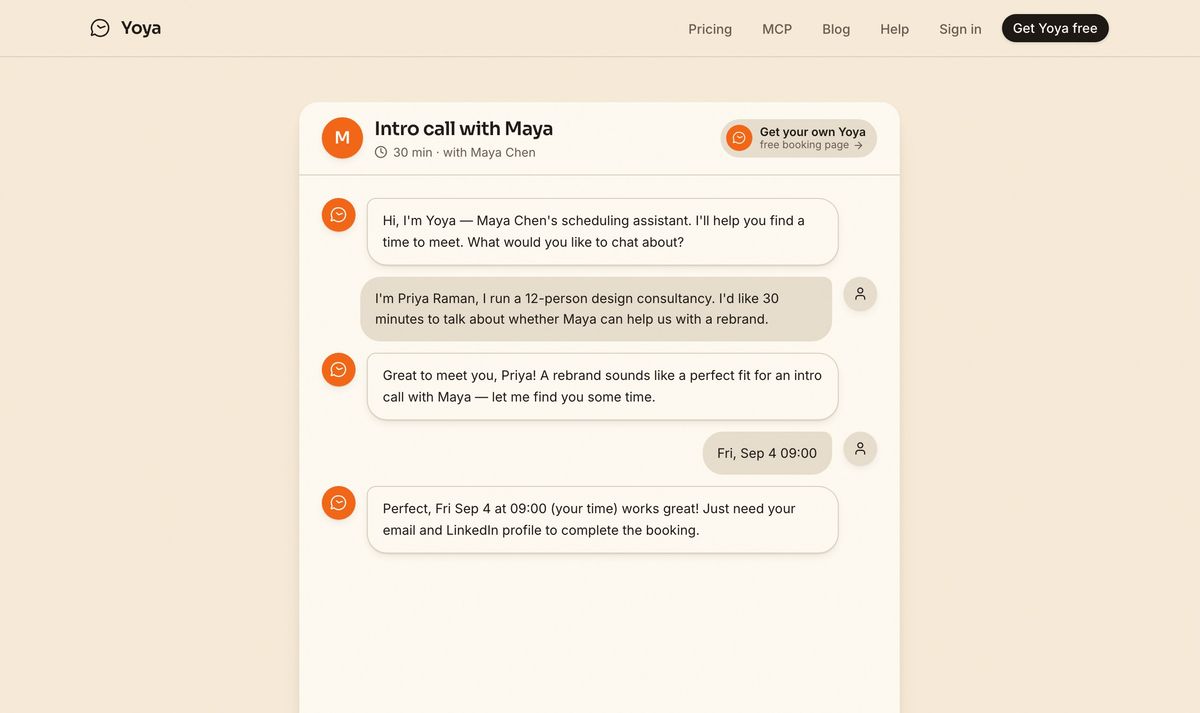
Required fields are asked for in the conversation rather than fronted as a form.
For the Talk to sales button specifically, Yoya ships an embeddable widget: one script tag, a launcher in the corner, and the conversation happens in a panel over your own page. The visitor never leaves the pricing page they were reading.
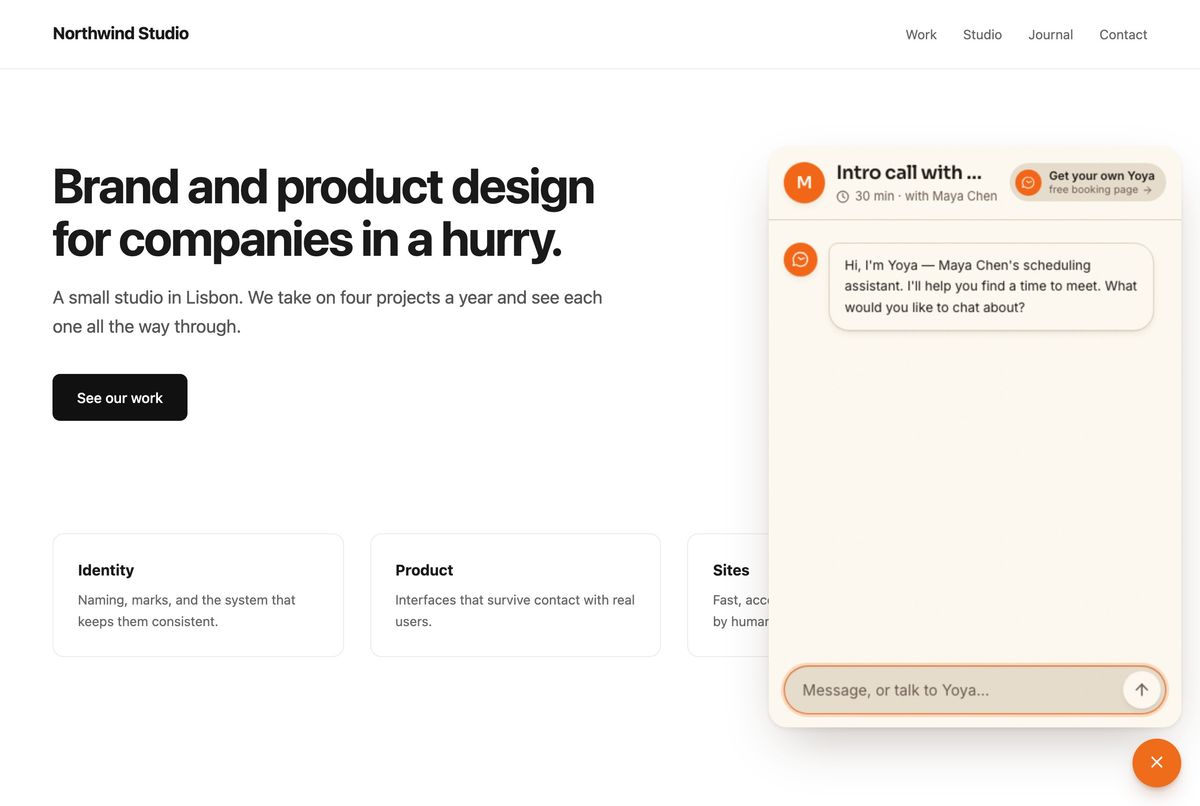
The widget on a site. Booking happens without a page change.
The comparison that matters
| Chili Piper | Yoya | |
|---|---|---|
| Entry price | $15,000/year, 15 seats included | Free, then $12/month |
| Commitment | Typically annual | Monthly, cancel any time |
| Booking from your site | Form → route → book | Conversation in a widget or link |
| Qualifying | Form fields, then routing rules | Asked for in the conversation |
| What the rep gets | Form answers + CRM record | A written brief of the conversation |
| Lead routing by territory/owner | Yes, this is the product | No |
| Salesforce / HubSpot writeback | Deep, native | No |
| Round-robin across a team | Yes | Business plan |
| Setup | Ops project | A script tag |
Read the bottom four rows carefully. If routing and CRM writeback are why you're shopping, Yoya is not your tool and I'd rather you knew that from a comparison table than from a trial.
Who should stay with Chili Piper
- You have a sales team large enough that who takes the meeting is a real decision with rules behind it.
- Salesforce or HubSpot is the system of record and the meeting has to land in it automatically.
- Inbound volume is high enough that queueing and live handoff matter.
- You already pay for it and it works.
Who should try the cheaper path
- Founder-led sales. The router has one destination: you.
- Small teams. Two or three people who can split by availability rather than territory.
- Agencies and consultancies where every enquiry is different and no set of form fields covers it.
- Anyone whose Talk to sales button currently goes to a contact form and a promise to get back to you. That's the actual competitor for most sites — not Chili Piper, but a form nobody answers until Tuesday.
Switching, honestly
The Talk to sales part takes about ten minutes: set your hours, paste one script tag before </body>, done. The parts that don't come with you are the routing rules and the CRM automation — if those exist and matter, this isn't a migration, it's a downgrade, and you should stay put.
If they don't exist yet, you can have the booked meeting and the brief today, and buy the router when you have the road for it.
Set up a free booking link and see what a conversation collects that a form doesn't. Or read how to embed the widget if the Talk to sales button is the whole reason you're here.
Sources: Chili Piper pricing · Chili Piper cost breakdown, Breakout · Chili Piper pricing guide, SchedulingKit