How to Calculate Meeting Cost, With a Worked Example
The Yoya TeamSep 13, 20263 min read

A one-hour meeting with six people uses six hours of attendee time. To estimate its cost, multiply the number of attendees by their average hourly cost and the meeting's duration in hours.
Meeting cost = attendees × average hourly cost × minutes ÷ 60.
You can use that formula in a spreadsheet or enter the values into Yoya's free meeting cost calculator. The result is an estimate of the cost of people's time. Whether the meeting was worth that time is a separate decision.
Example: five people, 30 minutes, twice a week
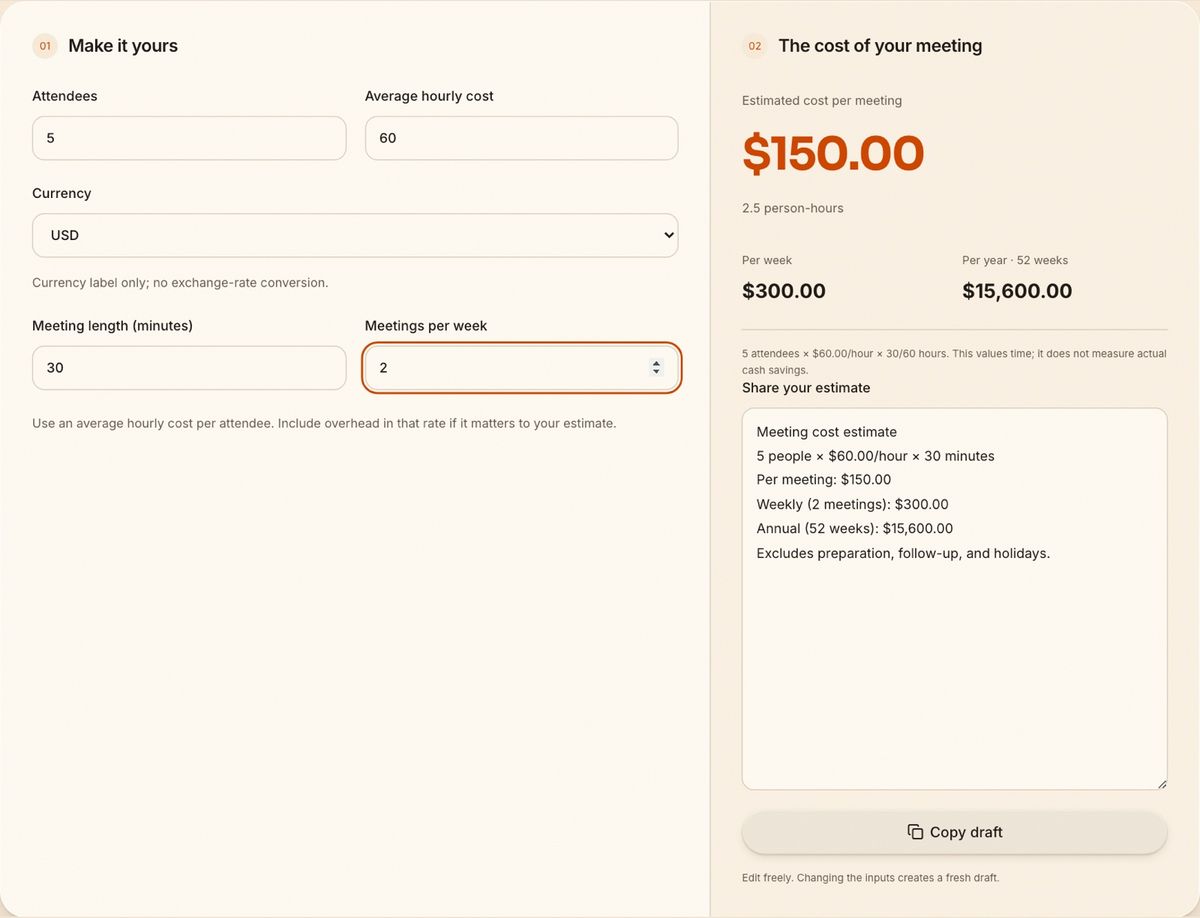
Assume five people attend a 30-minute meeting, their average hourly cost is $60, and they meet twice each week.
| Measure | Calculation | Estimate |
|---|---|---|
| Cost per meeting | 5 × $60 × 30 ÷ 60 | $150 |
| Person-hours per meeting | 5 × 30 ÷ 60 | 2.5 hours |
| Cost per week | $150 × 2 | $300 |
| Cost over 52 weeks | $300 × 52 | $15,600 |
This example assumes all five people attend every meeting for 52 weeks. It doesn't subtract holidays, vacation, or cancellations.
Enter those four values in the calculator to see the same estimate:
If the same five people meet for 20 minutes instead, the cost per meeting becomes $100. Across the same schedule, the difference is $5,200 in estimated attendee time and about 86.7 person-hours per year.
Change the meeting length to 20 minutes to see the difference:
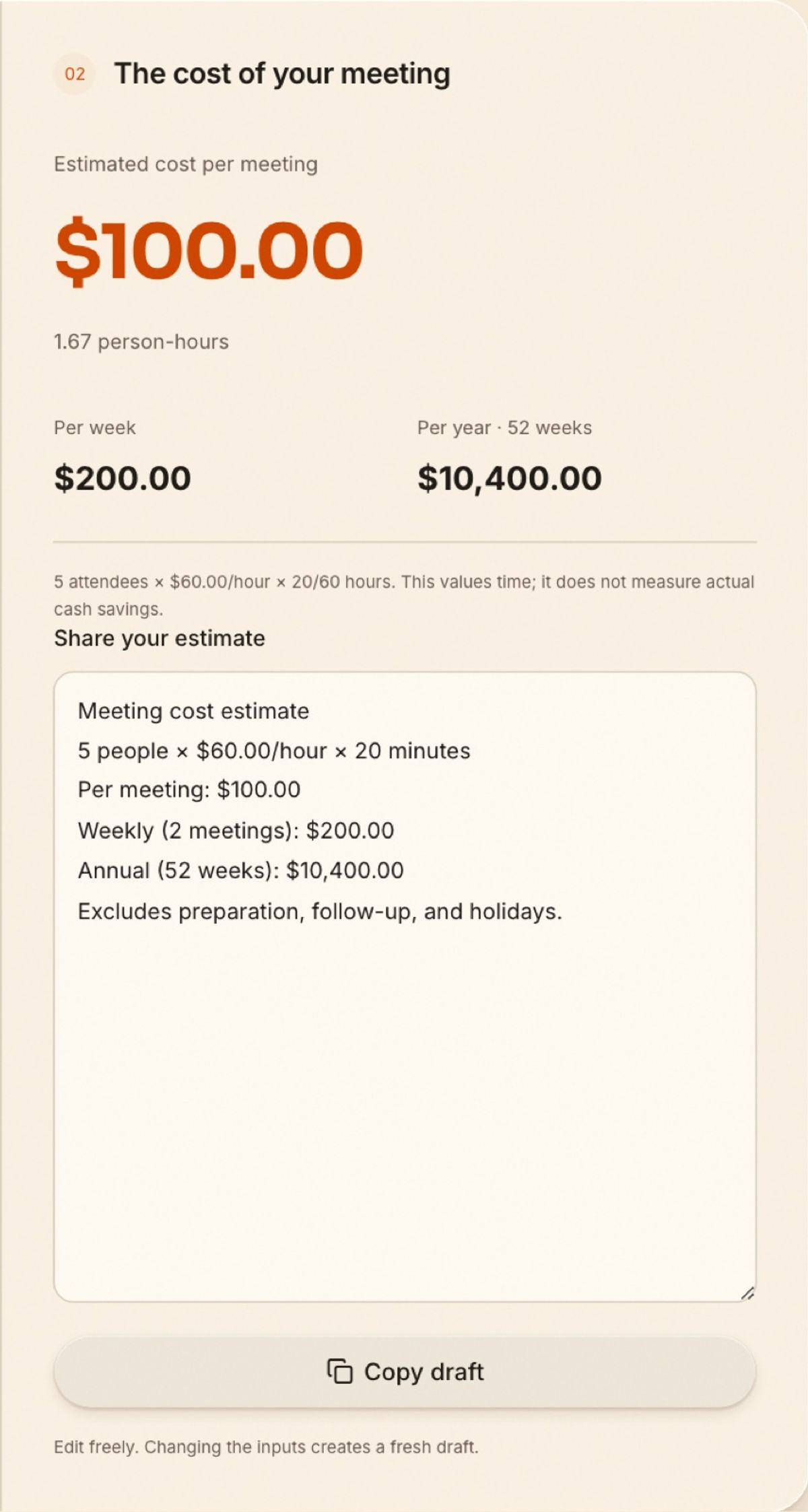
The $5,200 difference represents time available for other work. It isn't a reduction in payroll.
Choose an hourly cost you can explain
For a quick estimate, use an average hourly cost for the attendees. If their costs differ substantially, calculate each person's cost separately and add the results. Multiplying attendance by the average hourly cost gives the same total when everyone attends for the same duration.
If people join for different lengths of time, use a spreadsheet with a row for each attendee:
| Column | Value |
|---|---|
| A | Attendee or role |
| B | Hourly cost |
| C | Minutes attended |
| D | =B2*C2/60 for the first data row |
Copy the formula down and sum column D. A single shared-duration input would obscure that difference.
For a fully loaded estimate, use a rate that includes the employment costs your organization wants to count. State your assumptions. A client's billable rate, an employee's salary-derived rate, and total employment cost describe different things.
Yoya, Fellow, or a spreadsheet?
| Option | Useful for | Main consideration |
|---|---|---|
| Yoya's free calculator | A quick estimate from average hourly cost, duration, attendance, and weekly frequency | Uses a shared rate and duration, plus a 52-week annual assumption |
| Fellow's public calculator | Exploring the salary, frequency, and duration model described on its landing page | The current public entry form asks for business email and role |
| A spreadsheet | Different attendee rates, partial attendance, or a custom working-year assumption | You maintain the formulas and input quality |
Fellow's page currently shows the email form and describes a salary-based example. This comparison uses that public page; we didn't submit information or test the gated result. Source: Fellow's meeting cost calculator, reviewed September 13, 2026.
Use Yoya when you need a quick calculation without signing up. Use a spreadsheet when the shared assumptions don't fit. Changing Yoya's currency selector changes the label and formatting; it doesn't convert exchange rates.
Use the estimate to decide what to change
Start with a recurring meeting that lacks a clear output. Ask what decision it enables, which people need to make that decision, and what participants could read in advance. A useful meeting may be expensive and still worth keeping.
Our recommendation is to try one specific change before cancelling the whole meeting: reduce its scope, shorten it, or invite fewer people to the discussion and share the decision afterward. Check whether the decision still gets made. A shorter meeting that creates two follow-up calls may cost more overall.
For client calls, preparation is another place to look. Use the client intake questions generator to identify the context you need, then the discovery call agenda generator to give the conversation a time budget. Yoya's guide to preparing for a meeting covers the role of a pre-call brief.
Questions about the calculation
Does the estimate include preparation and follow-up?
No. Yoya's free calculator counts the entered meeting duration. Add preparation and follow-up separately if they matter to your decision.
Can the calculator tell me which meetings to cancel?
No. It estimates the cost of participants' time. You still need to evaluate the decision, coordination, or relationship the meeting supports.
How do I estimate a year with fewer working weeks?
Multiply the weekly estimate by the number of weeks you intend to count. Yoya's displayed annual estimate uses 52; use your own calculation when that assumption doesn't fit.